
The Future of Total Quality Management : Excellence, Efficiency & Evollution
The International TQM Conclave organized at Institute of Professional Studies (IPS) Business School in Jaipur represents an important academic and professional initiative aimed at promoting the principles of Total Quality Management (TQM) in modern organizations. The conclave brings together scholars, industry experts, researchers, and students to discuss the evolving role of quality management in achieving organizational excellence, operational efficiency, and sustainable development.
Total Quality Management is a strategic management philosophy that focuses on continuous improvement, customer satisfaction, and the involvement of all employees in improving organizational processes. The concept gained global recognition through the pioneering work of quality experts such as W. Edwards Deming, Joseph M. Juran, and Philip B. Crosby. Their ideas transformed the way organizations approach quality, shifting the focus from inspection and correction to prevention and continuous improvement.
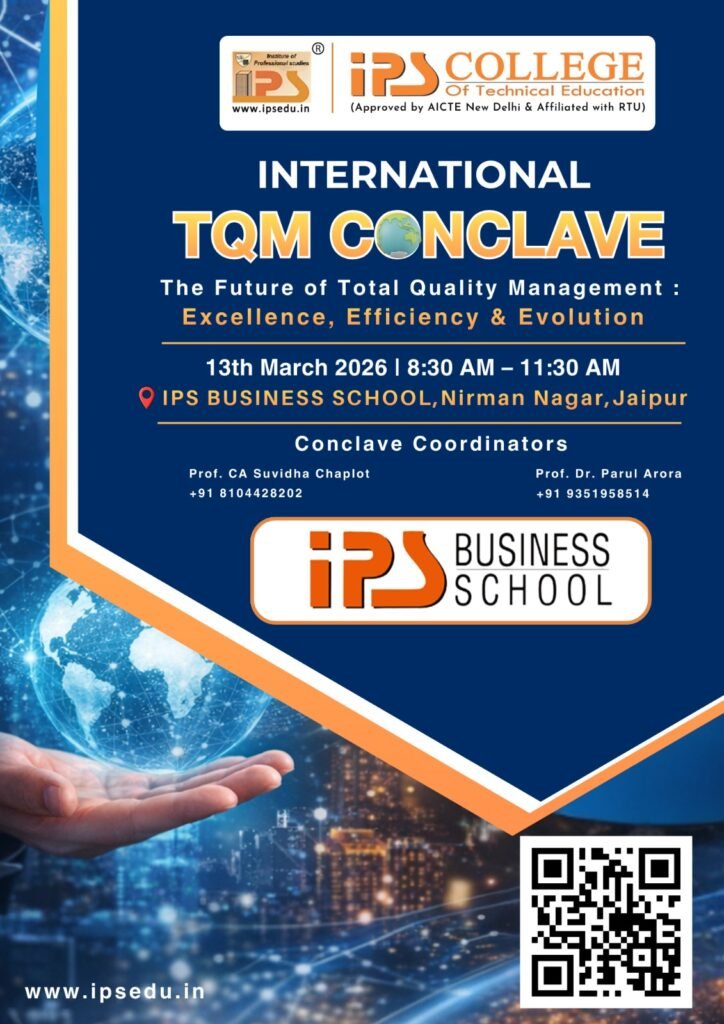
The International TQM Conclave at IPS College Jaipur aims to provide a global platform where participants can exchange ideas, present research findings, and explore innovative practices in quality management. Such events are particularly important in today’s competitive and rapidly changing business environment, where organizations must continuously adapt to technological advancements, globalization, and increasing customer expectations.
One of the key objectives of the conclave is to highlight the importance of excellence in organizational performance. Excellence in TQM refers to the ability of an organization to consistently deliver high-quality products and services while meeting the expectations of customers and stakeholders. Through keynote speeches, panel discussions, and research presentations, the conclave encourages participants to explore strategies for achieving excellence through effective leadership, strategic planning, and employee involvement.
Another important theme of the conclave is efficiency in organizational processes. In the modern business world, efficiency is essential for maintaining competitiveness and sustainability. Organizations are increasingly adopting advanced technologies such as automation, artificial intelligence, and data analytics to enhance productivity and reduce operational costs. The conclave provides an opportunity for industry experts and academics to discuss how these technologies can be integrated with TQM practices to improve process efficiency and ensure consistent quality standards.
The conclave also emphasizes the evolution of Total Quality Management in response to changing global trends. Traditionally, TQM was primarily associated with manufacturing industries. However, today it has expanded to various sectors such as healthcare, education, information technology, and service industries. Institutions like Institute of Professional Studies (IPS) Business School play a crucial role in promoting research and education in quality management, helping future professionals understand the importance of quality in all aspects of organizational operations.
Academic conferences such as the International TQM Conclave also encourage research and innovation. Researchers and scholars present their studies on topics such as quality improvement techniques, sustainable business practices, customer satisfaction strategies, and digital transformation in quality management. These discussions contribute to the development of new ideas and frameworks that can help organizations address emerging challenges in the global marketplace.
For students, the conclave serves as a valuable learning experience. By interacting with industry leaders and academic experts, students gain practical insights into the real-world application of TQM principles. Such exposure helps them develop critical thinking, research skills, and a deeper understanding of how quality management contributes to organizational success.
The event also strengthens the connection between academia and industry. Collaboration between educational institutions and business organizations is essential for bridging the gap between theoretical knowledge and practical application. Through the International TQM Conclave, IPS College Jaipur provides a platform where industry professionals can share their experiences and best practices, while researchers can present innovative solutions based on academic studies.
Another important aspect highlighted during the conclave is the role of leadership in quality management. Effective leadership is essential for building a culture of quality within organizations. Leaders must inspire employees to focus on continuous improvement, encourage teamwork, and promote a customer-oriented approach in all organizational activities. Discussions at the conclave explore how leadership strategies can support the successful implementation of TQM principles.
Furthermore, the conclave addresses the growing importance of sustainability and social responsibility in quality management. Modern organizations are expected not only to produce high-quality goods and services but also to operate responsibly by minimizing environmental impact and supporting social well-being. Integrating sustainability into TQM practices ensures long-term success while contributing to global development goals.
In conclusion, the International TQM Conclave at IPS College Jaipur represents a significant step toward promoting awareness, research, and practical application of Total Quality Management principles. By bringing together experts from academia and industry, the event encourages knowledge sharing, innovation, and collaboration. Such initiatives play a vital role in preparing future leaders and professionals to implement effective quality management practices that support excellence, efficiency, and continuous evolution in organizations.
Through this conclave, Institute of Professional Studies (IPS) Business School reaffirms its commitment to academic excellence and professional development. The event not only highlights the importance of quality management in today’s dynamic business environment but also inspires participants to contribute toward building organizations that prioritize quality, innovation, and sustainable grow